Der Bergsturz von Elm

Background
The slate business had a decisive influence on the history of the Sernf Valley for centuries. The brisk demand at home and abroad, especially in Germany, helped the various concession companies to make profitable profits. However, improper slate mining led to eleven million cubic meters of rock coming loose from the Tschingelberg at 5:15 p.m. on September 11, 1881.
The landslide
The Tschingelbach is buried, and the slate warehouses and the restaurant to the Martinsloch disappear under the rock masses. In panic, they start cleaning up. Intrepid people from the village rush to help.
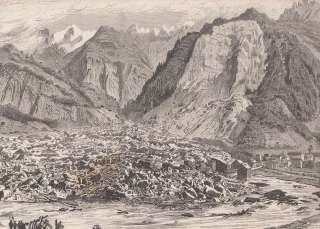
17 minutes later, the mountain seems to burst. A mighty mass of debris flies over the slate quarry and transforms the green meadows in the Untertal into a grey desert. In panic, people leave their homes. obsessed with saving the bare necessities.
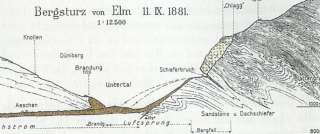
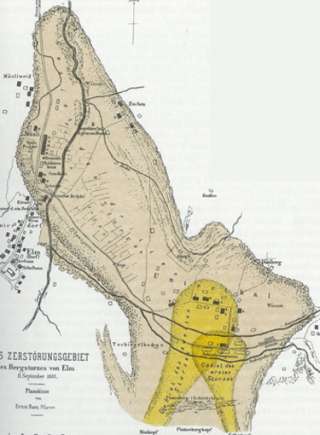
Barely four minutes later, the horrific happens. The whole Plattenbergkopf collapses. The huge masses of rock crowd down the valley in a cloud of dust darkening the sky, devour the fleeing people on the Düniberg, bury the entire part of the village in Untertal and smash houses and stables down to the Aeschen.
What remains is a huge grave. 114 lives have been extinguished. Beneath the rock masses lie 90 hectares of fertile soil, a considerable forest population, 83 buildings and the entire slate mine – the source of income for many inhabitants.
The next day, the first relief teams arrive, but there are no injured people to recover. The following Wednesday, the entire surviving congregation silently says goodbye forever on a mat above the church.
(Source: Elm-Sernftal Tourismus)
What the geologists say
The question of the cause or even responsibility for the landslide could not be answered clearly. None of the geologists and engineers summoned wanted to give a precise answer. However, they let it be understood that a rock that offers hundreds of crevices, cracks and fissures to seep in to the downpours on all sides should not be rummaged through with impunity. The experts also found that the starting line of the demolition, which started about 620 meters above the valley floor, led through forest and pastureland. However, the main mass of the landslide material (a little more than half in total) came from an altitude of about 350 to 400 meters. She had come loose over a distance of more than 300 meters and had fallen down over a scree heap that had also already been torn up.
(Source: Swiss Alpine Club SAC)
If you stand in front of the village church in Elm and look to the left past the church tower to the south, the bare landslide wall is clearly visible.