Bedrohung am Kilchenstock

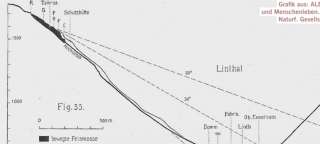
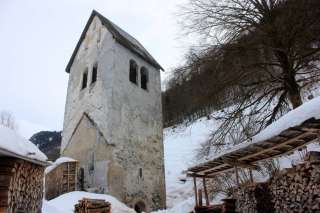
In the autumn of 1930, a large mass of rock threatened to break off from the Kilchenstock (1800 m) over the municipality of Linthal. The problem of unstable slopes was exacerbated by deforestation and runs eroding deep into the flanks as early as the 19th century. Stones fell on the church roof, whereupon the nave was demolished. Nevertheless, the local population did not see the situation as serious. As late as 1928, Hans Schardt, professor of geology at the Zurich Polytechnic, delivered a reassuring report that described a gradual crumbling of the mountain as likely, the local population did not see the situation as threatening.
But around 1929, the Kilchenstock drew attention to itself with its instability, when a wet summer with heavy rainfall repeatedly triggered rockfalls and debris flows that reached down to the village and caused severe damage.
On November 15, 1930, Albert Heim sent a telegram to the mayor of the canton of Glarus: "Crash seems near. Recommend order to evacuate and flee", as he realized that in the summit zone of the mountain a huge rock mass of about 100,000 m3 was sliding down to the valley at a speed of one centimeter per day.
A protective wall was eagerly built to keep the debris away from the village and 513 people were evacuated, causing many families to find themselves in need.
When the great landslide failed to materialize, there was a hail of harsh criticism of Albert Heim, the great pioneer of Swiss geology, whereupon he said:
"If he does not warn strongly and a fall comes unexpectedly, he is accused. If it warns very strongly, panic can ensue. And when it is a little quiet again, the geologist who has caused fear will be terribly condemned and accused, perhaps even in court."
In the night of November 6, 1932, about 20,000 m3 of rock collapsed into the valley, after which the mountain calmed down again.
The big catastrophe has not yet occurred, but small rockfalls or debris flows occur again and again on the Kilchenstock, triggered by the approximately 10 runs in the summit region, which bring a lot of debris during heavy rain.
Measures have already been implemented to contain the danger at Kilchenstock, including the construction of a bedload retention area that holds 10,000 m3 of bedload. Since it is gradually filled by debris flows, it has to be emptied every five to ten years.
(Source: geo-life)