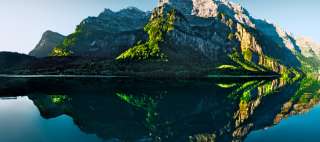
Der Bergsturz im Klöntal

Several thousand years ago, 77 million cubic metres of rock came loose in the Klöntal between Dejenstock and Gumenstock. This volume corresponds to a cube with a side length of almost one kilometre.
The part of the landslide mass that remained at the foot of the Dejenstock formed a bar (today known as the wooded Sackberg), which led to the damming of Lake Klöntal at that time. Due to the erosion terraces cut into the Sackberg, the Swiss geologist J. Oberholzer suspected that the lake mirror used to be 60m higher and that the Klöntalersee once had a length of 7km.
Today, Lake Klöntal, with a surface area of 3.3 square kilometres, is one of the smaller reservoirs in Switzerland. On the other hand, it is the oldest reservoir, as it has been used for electricity generation since 1908.
With its mostly mirror-smooth surface, in which the surrounding peaks of the mountains are reflected, it is not only one of the most important landslide lakes, but also one of the most beautiful reservoirs in Switzerland.
Even though swimming in the reservoir is prohibited, the trip to Klöntal is worthwhile to admire the beautiful landscape.