

Gand Forest, Elm

On a journey of discovery in the natural forest reserve.
The Gandwald near Elm is worth a visit for two reasons. In the rare Turin master maple forest, an impressive wealth of plants grows. In addition, the reserve is slowly developing into a primeval forest. Standing and lying deadwood are constant companions on the approximately two-hour hike.
GANDWALD NATURE TRAIL
Four different educational trail boards along the circular route provide information about the origin of the natural forest reserve (panel 1), the animals in the area (panels 2 and 5), the Turin master maple forest (panel 3) and the history of the Gandwald (panel 4). The following information serves as a supplement and helps to see, feel and discover the natural features in the area.
LEAVES & FLOWERS
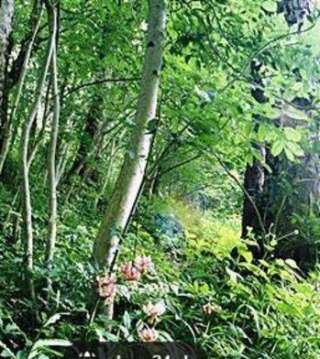
The Gandwald is home to a very rare forest community: the Turin Maple Forest. The forest is a real Glarus speciality. Throughout Switzerland, it only occurs in warmer foehn valleys such as the Sernftal. The maple stands around Elm are probably unique in Switzerland in terms of their extent.
The characteristics of the Turin master maple forest with its lush plant growth are described in detail on Plate 3. The eponymous herbaceous plant, the Turin master, is rather inconspicuous
with small white flower clusters. The flowering period is May to June. Four leaves of the plant are arranged on the same level around the stem. The plant is often confused with the woodruff. However, this does not grow quite as high and has six to nine finer ones
Leaves circling the stem. A colourful eye-catcher in the herb layer from June to July is the up to 90cm tall, pink-coloured, somewhat exotic-looking Turk's Bunch. The dominant tree species in the Turinermeister maple forest is the sycamore maple. It grows on wetter mountain areas and can also colonize unstable scree slopes. Its leaves can be recognized by the five lobes with the pointed bays in between. The bays of Norway maple are blunt
and the lobes have finely pointed teeth.
DEADWOOD HABITAT
Since 1995, the Gandwald has not been cultivated. This means that it is slowly developing into a primeval forest, i.e. a forest without human influence. Old trees that die are no longer removed. In this way, lying and standing deadwood accumulates. This is valuable for many living beings. Fungi colonize the wood and new tree and other seedlings germinate on it. Longhorned beetles eat
bark or wood and wild bees lay their brood in it. Mice, salamanders, grass snakes and other smaller animals hide under the lying trunks and branches. Caves in standing deadwood trees are inhabited by dormice, bats such as the brown long-eared bat, tawny owls and co. But even large animals such as the roe deer or red deer offer the lying deadwood privacy or delicacies in the form of the plant seedlings that are placed on it
grow. Further information about the animals can be found on panels 2 and 5.
GANDWALD NATURE TRAIL
Four different educational trail boards along the circular route provide information about the origin of the natural forest reserve (panel 1), the animals in the area (panels 2 and 5), the Turin master maple forest (panel 3) and the history of the Gandwald (panel 4). The following information serves as a supplement and helps to see, feel and discover the natural features in the area.
LEAVES & FLOWERS
The Gandwald is home to a very rare forest community: the Turin Maple Forest. The forest is a real Glarus speciality. Throughout Switzerland, it only occurs in warmer foehn valleys such as the Sernftal. The maple stands around Elm are probably unique in Switzerland in terms of their extent.
The characteristics of the Turin master maple forest with its lush plant growth are described in detail on Plate 3. The eponymous herbaceous plant, the Turin master, is rather inconspicuous
with small white flower clusters. The flowering period is May to June. Four leaves of the plant are arranged on the same level around the stem. The plant is often confused with the woodruff. However, this does not grow quite as high and has six to nine finer ones
Leaves circling the stem. A colourful eye-catcher in the herb layer from June to July is the up to 90cm tall, pink-coloured, somewhat exotic-looking Turk's Bunch. The dominant tree species in the Turinermeister maple forest is the sycamore maple. It grows on wetter mountain areas and can also colonize unstable scree slopes. Its leaves can be recognized by the five lobes with the pointed bays in between. The bays of Norway maple are blunt
and the lobes have finely pointed teeth.
DEADWOOD HABITAT
Since 1995, the Gandwald has not been cultivated. This means that it is slowly developing into a primeval forest, i.e. a forest without human influence. Old trees that die are no longer removed. In this way, lying and standing deadwood accumulates. This is valuable for many living beings. Fungi colonize the wood and new tree and other seedlings germinate on it. Longhorned beetles eat
bark or wood and wild bees lay their brood in it. Mice, salamanders, grass snakes and other smaller animals hide under the lying trunks and branches. Caves in standing deadwood trees are inhabited by dormice, bats such as the brown long-eared bat, tawny owls and co. But even large animals such as the roe deer or red deer offer the lying deadwood privacy or delicacies in the form of the plant seedlings that are placed on it
grow. Further information about the animals can be found on panels 2 and 5.
Price information

Event date
Address
8767
Elm
Contact


Verantwortlich für diesen Inhalt: VISIT Glarnerland AG
Fehler melden (ID: civ_s9t_ieibbhut-rsgj-ehaq-irja-rfdiuhbfatuq)
Fehler melden (ID: civ_s9t_ieibbhut-rsgj-ehaq-irja-rfdiuhbfatuq)